Showing posts with label python. Show all posts

Friday, December 18, 2015

Count of Smaller Numbers After Self [LeetCode]

Problem Description
You are given an integer array nums and you have to return a new counts array. The counts array has the property where counts[i] is the number of smaller elements to the right of nums[i].
Example:
Given nums = [5, 2, 6, 1]

To the right of 5 there are 2 smaller elements (2 and 1).
To the right of 2 there is only 1 smaller element (1).
To the right of 6 there is 1 smaller element (1).
To the right of 1 there is 0 smaller element.
Return the array [2, 1, 1, 0].
Solution
In this post, I'm going to write a little bit about Binary Indexed Tree and its application to solve the above problem. The problem itself is not really hard. We can solve it using many ways, including Binary Search Tree, Segment Tree, Sorting, or language specific way such as using lower_bound in C++, TreeSet (or SortedSet) in Java with method lower  (see some at the end) .
Once we know how to use Binary Indexed Tree or shortly BIT, we can solve many other problems, especially in programming contests since BIT is very easy to implement.

I suggest that you spend some time to read this article from Topcoder: Binary Indexed Tree.
Basically, in this problem, we use BIT to count the number of integers that are less than a specific number.
Suppose that a number N = A1B > 0 in binary representation, where B contains all 0 . The array tree is a BIT where tree[N] count the number of integers that are from A0B and A1B - 1 .
So if we call f[N] is the number of integers that are less than N, how we calculate its value?
Yes, you are correct, f[N] = tree[N] + f[A0B] (where A0B is in binary representation).
We also know that A0B = N & (N-1) using bit manipulation. (NOTE: on the Topcoder, they use A0B= N - (N & -N) .  
Having this in mind, to solve the problem we run from the back of the array, try each element. At the position i , we can simply calculate f[nums[i]] and put it into the result. However, we need to update the BIT here, because we have found another integer. So the natural question is which element we need to update in the BIT? Obviously, we need to update tree[N+1] by increasing its value by 1. But we do not stop there. Let N+1 = C1D where D has all 0 . As you can see, let  g[N+1] = C1D + 1D , we need to update g[N+1] also. And in turn, we need to update g[g[N+1]],so on...

Let's see the following Java code for implementation.
public class Solution {
    
    /*
    In this solution, we use a binary indexed tree (BIT)
    Our assumption is that all elements in nums are positive
    */
    
    static int MAX = 11000; //we set max value that can be store in the tree
    int[] tree = new int[MAX];
    
    public List<Integer> countSmaller(int[] nums) {
        Integer[] result = new Integer[nums.length];
        
        //make all elements in the array posive while maintaining their order
        makePositive(nums);
    
        for(int i=nums.length-1; i>=0; i--){
            result[i] = get(nums[i]);
            add(nums[i]+1, 1);
        }
        return Arrays.asList(result);
    }
    
    public void makePositive(int[] nums){
        int min = MAX;
        for(int i=0; i<nums.length; i++)    
            min = Math.min(min, nums[i]);
        if(min < 0){
            min = -min+1;
            for(int i=0; i<nums.length; i++)
                nums[i] += min;
        }
    }
    
    public void add(int idx, int val){
        while(idx<MAX){
            tree[idx] += val;
            idx += (idx & (-idx));
        }
    }
    
    public int get(int idx){
        int result = 0;
        while(idx>0){
            result += tree[idx];
            idx &= (idx-1);
        }
        return result;
    }
}
Appendix A: Binary search Tree solution (Java) - Credited to  yavinci
public class Solution {
    class Node {
        Node left, right;
        int val, sum, dup = 1;
        public Node(int v, int s) {
            val = v;
            sum = s;
        }
    }
    public List<Integer> countSmaller(int[] nums) {
        Integer[] ans = new Integer[nums.length];
        Node root = null;
        for (int i = nums.length - 1; i >= 0; i--) {
            root = insert(nums[i], root, ans, i, 0);
        }
        return Arrays.asList(ans);
    }
    private Node insert(int num, Node node, Integer[] ans, int i, int preSum) {
        if (node == null) {
            node = new Node(num, 0);
            ans[i] = preSum;
        } else if (node.val == num) {
            node.dup++;
            ans[i] = preSum + node.sum;
        } else if (node.val > num) {
            node.sum++;
            node.left = insert(num, node.left, ans, i, preSum);
        } else {
            node.right = insert(num, node.right, ans, i, preSum + node.dup + node.sum);
        }
        return node;
    }
}
Appendix B: Segment Tree Solution (Javascript) - Credited to opmiss.
/**
 * @param {number[]} nums
 * @return {number[]}
 */
var countSmaller = function(nums) {
    if (nums.length<1) return []; 
    var SegmentTreeNode = function(s, e){
        this.start = s;
        this.end = e; 
        this.left = null; 
        this.right = null; 
        this.count = 0; 
    }; 
    var max = nums[0]; 
    var min = nums[0]; 
    nums.forEach(function(num){
        max = (max<num)?num:max; 
        min = (min>num)?num:min; 
    }); 
    var root = new SegmentTreeNode(min, max);
    var insert = function(node, num){
        ++node.count; 
        if (node.start===node.end){
            return 0; 
        }
        if (node.left===null){
            var mid = (node.start+node.end)>>1; 
            node.left = new SegmentTreeNode(node.start, mid); 
            node.right = new SegmentTreeNode(mid+1, node.end); 
        }
        if (num>node.left.end){
            var res=node.left.count+insert(node.right, num);
            return res; 
        }
        return insert(node.left, num); 
    }; 

    var res = []; 
    while (nums.length>0){
       res.unshift(insert(root, nums.pop()));  
    }
    return res; 
};
Appendix C: Merge sort (Java) - Credited to  lzyfriday.
int[] count;
public List<Integer> countSmaller(int[] nums) {
    List<Integer> res = new ArrayList<Integer>();     

    count = new int[nums.length];
    int[] indexes = new int[nums.length];
    for(int i = 0; i < nums.length; i++){
        indexes[i] = i;
    }
    mergesort(nums, indexes, 0, nums.length - 1);
    for(int i = 0; i < count.length; i++){
        res.add(count[i]);
    }
    return res;
}
private void mergesort(int[] nums, int[] indexes, int start, int end){
    if(end <= start){
        return;
    }
    int mid = (start + end) / 2;
    mergesort(nums, indexes, start, mid);
    mergesort(nums, indexes, mid + 1, end);

    merge(nums, indexes, start, end);
}
private void merge(int[] nums, int[] indexes, int start, int end){
    int mid = (start + end) / 2;
    int left_index = start;
    int right_index = mid+1;
    int rightcount = 0;     
    int[] new_indexes = new int[end - start + 1];

    int sort_index = 0;
    while(left_index <= mid && right_index <= end){
        if(nums[indexes[right_index]] < nums[indexes[left_index]]){
            new_indexes[sort_index] = indexes[right_index];
            rightcount++;
            right_index++;
        }else{
            new_indexes[sort_index] = indexes[left_index];
            count[indexes[left_index]] += rightcount;
            left_index++;
        }
        sort_index++;
    }
    while(left_index <= mid){
        new_indexes[sort_index] = indexes[left_index];
        count[indexes[left_index]] += rightcount;
        left_index++;
        sort_index++;
    }
    while(right_index <= end){
        new_indexes[sort_index++] = indexes[right_index++];
    }
    for(int i = start; i <= end; i++){
        indexes[i] = new_indexes[i - start];
    }
}
Appendix D: Merge sort (Python) - Credited to StefanPochmann
def countSmaller(self, nums):
    def sort(enum):
        half = len(enum) / 2
        if half:
            left, right = sort(enum[:half]), sort(enum[half:])
            for i in range(len(enum))[::-1]:
                if not right or left and left[-1][1] > right[-1][1]:
                    smaller[left[-1][0]] += len(right)
                    enum[i] = left.pop()
                else:
                    enum[i] = right.pop()
        return enum
    smaller = [0] * len(nums)
    sort(list(enumerate(nums)))
    return smaller

Wednesday, December 9, 2015

[Hackerrank] Manasa and Prime Game

Problem Description (Credited to Hackerrank)
Manasa loves the NIM Game, but having played the same game so many times, she gets bored one day. So she wants to change the rules of the game. As she loves prime numbers, she makes a new rule: any player can remove only prime number of balls from a bucket. But there are infinite prime numbers. So to keep the game simple, a player can remove only x number of balls from a bucket, where x belongs to the set S.


 S={2,3,5,7,11,13}


Now whole game can be described as follows:
Given N number of buckets and kth bucket having Ak number of balls, a player can choose a bucket and remove x number of balls from that bucket where x belongs to S. Manasa plays the first move against Sandy. Who will win if both of them play optimally?

Input Format 
The first line contains an integer T i.e. the number of test cases.
First line of each test case will contain an integer N i.e. number of buckets.
Next lines will contain N integers.

Output Format 
Print the name of the winner - "Manasa" or "Sandy".

Constraints
1T10 
1N104 
1Ak1018

Sample Input
2
2
10 10
3
2 2 3
Sample Output
Sandy
Manasa
Solution

This is another example of problems in game theory. If Permutation Game is solved using Minimax algorithm, this problem requires some knowledge about Nim games, and Grundy number (or Nimber).
You can read more about Nim Games and Grundy number using reference links at the end of the post, but I will describe it shortly so that you get how to do (even without understanding Nim Games and Grundy numbers!!!).

In this type of problem, one game is a combination of multiple sub-games. At each time, a player chooses a sub-game to play. Who is the last person to make a move is the winner. And to decide who is the winner, we need to calculate Grundy numbers for all the sub-games, and take the XOR value of them. If this value > 0, then the first player is the winner. Otherwise, the second player is the winner !!! Sound like magic? Again, I suggest you read through everything I put in reference links to understand the theory behind.

So what is the sub-games here? Assuming that the 2 players play only with a bucket. So this is a sub-game.

Now, how to calculate Grundy number for a sub-game? Call C is the current state of the sub-game (In this problem, C is the number of balls in the bucket). Call T1, T2, ..., Tn are all possible states can be reached from C within a single move. And call G is a function on these states. G is defined as followed:

G map a state to non-negative integer.
G(losing state) = 0
G(C) = smallest number that not in the set {G(T1), G(T2), ..., G(Tn)} where T1, T2, ..., Tn are all possible states reached from current state C by a single move.

How to apply for this problem?
First, we need to define losing state. Losing state is the state a player cannot remove balls. In this problem, losing states are 0 and 1. Therefore, we have G(0) = G(1) = 0.

So we have: G(2) = 1. (Why?), G(3) = 1 (Why?), G(4) = 2 (Why?), and so on.

And the problem ask us to calculate Grundy number for 1<=Ak <= 10^18!
The Grundy number G(Ak) can be calculated using Dynamic Programming if Ak is small. But 10^18 is way too big. We have to find another way.

We see that, from the current state C, we can only move to maximum 6 other states. This means that the Grundy numbers may be at most 6 (Why?). That means there is a high chance that they are periodic! Yes, they are periodic.

Hence, I wrote a quick Python script to see if it is periodic.
def run():
  n = 100
  dp = [0]*(n+1)
  a = [2,3,5,7,11,13]
  b = [0] * (23)
  for i in range(2, n+1):
    for k in a:
      if i >= k:
        b[dp[i-k]]= 1
    for k in range(len(b)):
      if b[k] == 0: 
        dp[i] = k
        break
    for k in range(len(b)): b[k] = 0
  print dp
if __name__ == "__main__":
  run()

And the result is
[0, 0, 1, 1, 2, 2, 3, 3, 4, 0, 0, 1, 1, 2, 2, 3, 3, 4, 0, 0, 1, 1, 2, 2, 3, 3, 4, 0, 0, 1, 1, 2, 2, 3, 3, 4, 0, 0, 1, 1, 2, 2, 3, 3, 4, 0, 0, 1
, 1, 2, 2, 3, 3, 4, 0, 0, 1, 1, 2, 2, 3, 3, 4, 0, 0, 1, 1, 2, 2, 3, 3, 4, 0, 0, 1, 1, 2, 2, 3, 3, 4, 0, 0, 1, 1, 2, 2, 3, 3, 4, 0, 0, 1, 1, 2,
2, 3, 3, 4, 0, 0]

So the period will be values = [0, 0, 1, 1, 2, 2, 3, 3, 4]. Simple, isn't it?
And G(Ak) = values[ Ak % 9].
Now, we just need to XOR up all Grundy numbers G(A1) ^ G(A2) ^ ... ^ G(An).

Below is the code in java for your reference.
Before seeing the solution, try yourself with the following test case:
5
10
84 87 78 16 94 36 87 93 50 22
10
63 28 91 60 64 27 41 27 73 37
10
12 69 68 30 83 31 63 24 68 36
10
30 3 23 59 70 68 94 57 12 43
10
30 74 22 20 85 38 99 25 16 71
import java.io.*;
import java.util.*;
import java.text.*;
import java.math.*;
import java.util.regex.*;

public class Solution {

    public static void main(String[] args) {
        int t = ni();
        for(int i=0; i<t; i++){
            System.out.println(solve());
        }
    }
    
    public static int[] values = new int[]{0, 0, 1, 1, 2, 2, 3, 3, 4};
    public static String solve(){
        int n = ni();
        long ak;
        long nimber = 0; //or grundy number
        for(int i=0; i<n; i++){
            ak = nl();
            nimber ^= values[(int) (ak % values.length)];
        }
        if(nimber > 0) return "Manasa";
        return "Sandy";
    }
    
    public static Scanner sc = new Scanner(System.in);
    public static int ni(){
        return sc.nextInt();
    }
    public static long nl(){
        return sc.nextLong();
    }
}

Reference links:
Combinatorial Games - PDF (Standford course)
Sprague-Grundy Theorem (Wiki)
Grundy Numbers (Nice blog post)

Wednesday, September 9, 2015

Perfect Squares [LeetCode] Part 2: Solve it Mathematically

This is continuation of the previous post - Perfect Squares. I've decided to separate the problem into two parts because the solution using maths knowledge recalled me the happy time when I studied maths in high school.

Before we start, I want to confirm that all the returned values will always be in range [1,4] inclusively. Why is that? It is because we have Lagrange's Four Square Theorem, also known as Bachet's conjecture:
Every natural numbers can be expressed as a sum of four square numbers. (*)

The theorem is proved by Lagrange in 1770. To understand the proof, I suggest you read the provided link from Wiki. And later, the talented mathematician Ramanujan did a generalization on the theorem.  I have to say it is extremely sad that Ramanujan's life was too short, even though his legacy is more than 3900 results (mostly identities and equations).

As a note, many proofs of the theorem use the Euler's four square identity:
Picture 1: Euler's Four Square Identity

Now I suggest you read this page. After reading it, you can solve this LeetCode problem mathematically! And you can also understand the algorithm to represent a natural number as a sum of four perfect squares!

Let me help you to summarize the related part of it.
From the article, you can find that if a number is in the form n = 4^r (8k+7) (Where ^ is power), then n cannot be represented as a sum of less than 4 perfect squares. If n is not in the above form, then n can be represented as a sum of 1, 2, or 3 perfect squares.

So now you know the basic theory behind, we can start coding!

I. Python Code
class Solution(object):
    
    def is_square(self, n):
        temp = int(math.sqrt(n))
        return temp*temp == n
        
    def numSquares(self, n):
        """
        :type n: int
        :rtype: int
        """
        while n & 3 == 0: #n % 4
            n = n >> 2
        if n % 8 == 7: return 4
        
        sqrt_n = int(math.sqrt(n))
        if self.is_square(n): return 1
        else:
            for i in range(1, sqrt_n+1):
                if self.is_square(n-i*i):
                    return 2
        return 3
II. Java Code
public class Solution {
    public boolean is_square(int n){
        int temp = (int) Math.sqrt(n);
        return temp * temp == n;
    }
    public int numSquares(int n) {
        while ((n & 3) == 0) //n % 4 == 0
            n >>= 2;
        if ((n & 7) == 7) return 4; //n% 8 == 7
        
        if(is_square(n)) return 1;
        int sqrt_n = (int) Math.sqrt(n);
        for (int i = 1; i<= sqrt_n; i++){
            if (is_square(n-i*i)) return 2;
        }
        return 3;
    }
}
III. C++ Code
class Solution {
public:
    int is_square(int n){
        int temp = (int) sqrt(n);
        return temp * temp == n;
    }
    int numSquares(int n) {
        while ((n & 3) == 0) //n%4 == 0
            n >>= 2;
        if ((n & 7) == 7) return 4; //n % 8 == 7
        if(is_square(n)) return 1;
        int sqrt_n = (int) sqrt(n);
        for(int i = 1; i<= sqrt_n; i++){
            if (is_square(n-i*i)) return 2;
        }
        return 3;
    }
};
IV. Javascript Code
/**
 * @param {number} n
 * @return {number}
 */
var is_square = function(n){
    var t = Math.floor(Math.sqrt(n));
    return t * t == n;
}
var numSquares = function(n) {
    while ((n & 3) ===0) //n%4 == 0
        n >>=2;
    if((n&7) == 7) return 4; //n % 8 = 7
    if(is_square(n)) return 1;
    var sqrt_n = Math.floor(Math.sqrt(n));
    for(var i=1; i<= sqrt_n; i++){
        if(is_square(n-i*i)) return 2;
    }
    return 3;
};

Perfect Squares [LeetCode]

Problem Description
Given a positive integer n, find the least number of perfect square numbers (for example, 1, 4, 9, 16, ...) which sum to n.
For example, given n = 12, return 3 because 12 = 4 + 4 + 4; given n = 13, return 2 because 13 = 4 + 9.
Solutions

I. Dynamic Programming
This problem can be solved by dynamic programming. If we call dp is the array of least numbers of perfect square numbers for each integer from 1 to n, we have the following relation:
dp[n] = 1 + min (dp[n-i*i] for i from 1 to square root of n)
However, (as of 2015-09-09) I saw people complain that the dynamic programming solution got Time Limit Exception (TLE) with Python. Therefore, StefanPochmann, a member of LeetCode, solved the solution by using "Static" dynamic programming. That means the array dp is a static variable of the class Solution.
Dynamic Programming C++ Code
int numSquares(int n) {
    static vector<int> dp {0};
    while (dp.size() <= n) {
        int m = dp.size(), squares = INT_MAX;
        for (int i=1; i*i<=m; ++i)
            squares = min(squares, dp[m-i*i] + 1);
        dp.push_back(squares);
    }
    return dp[n];
}
Dynamic Programming C++ : Reverse for-loops inside out
int numSquares(int n) {
    static vector<int> dp {0};
    int m = dp.size();
    dp.resize(max(m, n+1), INT_MAX);
    for (int i=1, i2; (i2 = i*i)<=n; ++i)
        for (int j=max(m, i2); j<=n; ++j)
            if (dp[j] > dp[j-i2] + 1)
                dp[j] = dp[j-i2] + 1;
    return dp[n];
}
Dynamic Programming Python Code
class Solution(object):
    _dp = [0]
    def numSquares(self, n):
        dp = self._dp
        while len(dp) <= n:
            dp += min(dp[-i*i] for i in range(1, int(len(dp)**0.5+1))) + 1,
        return dp[n]
Dynamic Programming Ruby Code
$dp = [0]
def num_squares(n)
  $dp << (1..$dp.size**0.5).map { |i| $dp[-i*i] }.min + 1 until $dp[n]
  $dp[n]
end

However, in Python, if you test that code with test case 1,000,000, you will get the TLE error.
NOTE: I'm very happy that LeetCode now provides testing against custom input (From 2015-09-09). This feature I've seen in Hackerrank and wanted LeetCode to implemente it for quite a long time ago.

II. Breadth First Search

Picture 1: Graph of numbers 
In this problem, we define a graph where each number from 0 to n is a node. Two numbers p < q is connected if (q-p) is a perfect square.
So we can simply do a Breadth First Search from the node 0.
Below is the Python code that even can pass the custom test case of 1,000,000.
Breadth First Search Python Code
class Solution(object):
    _dp = [0]
    def numSquares(self, n):
        """
        :type n: int
        :rtype: int
        """
       
        q1 = [0]
        q2 = []
        level = 0
        visited = [False] * (n+1)
        while True:
            level += 1
            for v in q1:
                i = 0
                while True:
                    i += 1
                    t = v + i * i
                    if t == n: return level
                    if t > n: break
                    if visited[t]: continue
                    q2.append(t)
                    visited[t] = True
            q1 = q2
            q2 = []
                
        return 0
PS: For now, I do not have very much time to write the code in Java, C++, C#, Javacript or Ruby, so you are extremely welcome to post your solutions as a comment!

Monday, September 7, 2015

First Bad Version [LeetCode]

Problem Description
You are a product manager and currently leading a team to develop a new product. Unfortunately, the latest version of your product fails the quality check. Since each version is developed based on the previous version, all the versions after a bad version are also bad.
Suppose you have n versions [1, 2, ..., n] and you want to find out the first bad one, which causes all the following ones to be bad.
You are given an API bool isBadVersion(version) which will return whether version is bad. Implement a function to find the first bad version. You should minimize the number of calls to the API.
Solution
This is a typical example of type of binary search that does not return immediately after finding the satisfied element.
Suppose we have 2 pointers start and end. We take middle = (start + end) / 2. Now we check if middle is a bad version. If it is yes, we do not stop here, but we will search on the left, in order to find out that whether there is some smaller bad version. By going to the left, we set end = middle - 1. So if we find nothing on the left, we return end + 1, because it is the last time we saw a bad version. If middle is not a bad version, we simply go to the right by setting start = middle + 1.

One thing to note is that in some programming language, to avoid overflow, we use (end-start)/2 + start instead of (start + end)/2
I. Python Code
# The isBadVersion API is already defined for you.
# @param version, an integer
# @return a bool
# def isBadVersion(version):

class Solution(object):
    def firstBadVersion(self, n):
        """
        :type n: int
        :rtype: int
        """
        start, middle, end = 1, 1, n
        while start <= end:
            middle = (start + end) >> 1
            if isBadVersion(middle): end = middle - 1
            else: start = middle + 1
        return end + 1
II. Java Code
/* The isBadVersion API is defined in the parent class VersionControl.
      boolean isBadVersion(int version); */

public class Solution extends VersionControl {
    public int firstBadVersion(int n) {
        int start = 1;
        int end = n;
        int middle;
        while(start <= end){
            middle = ((end - start)>>1) + start;
            if (isBadVersion(middle)) end = middle - 1;
            else start = middle + 1;
        }
        return end + 1;
    }
}
III. C++ Code
// Forward declaration of isBadVersion API.
bool isBadVersion(int version);

class Solution {
public:
    int firstBadVersion(int n) {
        int start = 1;
        int end = n;
        int middle;
        while(start <= end){
            middle = ((end-start)>> 1) + start;
            if(isBadVersion(middle)) end = middle - 1;
            else start = middle + 1;
        }
        return end + 1;
    }
};
IV. Javascript Code
/**
 * Definition for isBadVersion()
 * 
 * @param {integer} version number
 * @return {boolean} whether the version is bad
 * isBadVersion = function(version) {
 *     ...
 * };
 */

/**
 * @param {function} isBadVersion()
 * @return {function}
 */
var solution = function(isBadVersion) {
    /**
     * @param {integer} n Total versions
     * @return {integer} The first bad version
     */
    return function(n) {
        var start = 1;
        var end = n;
        while(start <= end){
            var middle = ((end-start) >> 1) + start;
            if (isBadVersion(middle)) end = middle - 1;
            else start = middle + 1;
        }
        return end + 1;
    };
};

Sunday, September 6, 2015

H-Index II [LeetCode]

Problem Description
Follow up for H-Index: What if the citations array is sorted in ascending order? Could you optimize your algorithm?
Solution
In the previous version, we sorted citations in reverse order. In this version of problem, the citations array is in ascending order.
I. O(n) Solution
As we already know in the previous version of finding H-Index, we can solve the problem in linear time. Below is the 1-line Python solution:
class Solution(object):
    def hIndex(self, citations):
        """
        :type citations: List[int]
        :rtype: int
        """
        return max(min(v, len(citations)-k) for k, v in enumerate(citations + [0]))
II. O(logn) Solution
Since we already knew about how to solve the problem in linear time, we try to find another solution. As usual, the idea is to find O(logn) solution by binary search.
Our normal logic when using binary search is that we have a start and end point. We will check the middle= (start + end) /2. (In some language, to avoid overflow we can use (end-start)/2 + start )
What we need to find out now is when we should stop the search, or going to left or right.


1. When we should stop?
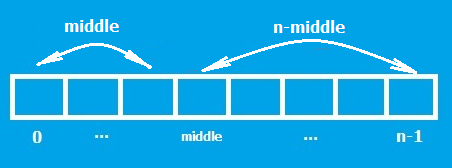
Suppose that middle is not in final stage (where start > end) and we decide to stop. There are (n-middle) elements are at least citations[middle], and other (middle ) elements are at most citations[middle]. This suggests that if citations[middle] = (n-middle) = h (where n is the number of elements in citations),  then we have at least h elements are at least h, and other middle = n-h elements are at most h. So h is an H-index.
Is it h  the largest? Suppose there is another h" > h and h" is also an H-index. Consider the element at n-h". Since there are at least h" elements which are at least h", then citations[n-h"] >= h">h. However, we have n-h" < n-h, therefore citations[n-h"] < citations[n-h] = h, or we have h > h. This is contradictory. So h is the largest H-index. This means that we should stop the search here!

2. When we should go to the left and right
The analysis in (1) suggest that we should compare citations[middle] and (n-middle) in order to decide whether we should go to left or right in binary search.

a. If citations[middle] < n-middle
Is it possible to stop or go left in this case? Suppose it is. That means there is a number h >= n-middle, and h is an H-index. Then there are h elements which are at least h. Therefore:
citations[n-h] > h >= n-middle > citations[middle]
However,
h >= n-middle  => middle >= n-h
That means citations[n-h] <= citations[middle]. This is contradictory.
So we should go to the right in this case.

b. If citations[middle] > n-middle
This is not same as the case (a). Easily we can see that h = n-middle is an H-index. But there might be other elements on the left satisfy the H-index condition. So we simply go to the left to search more.
Note that the current position is end + 1 after we set the end pointer to middle-1. And also, while searching on the left, if we go to the left another time, then current h= n-middle is not the largest H-index. But if we never go to the left again, then the pointer end keeps unchanged, so we can simply return n-end-1 when the search is terminated.
We come to coding now.

I. Python Code
class Solution(object):
    def hIndex(self, citations):
        """
        :type citations: List[int]
        :rtype: int
        """
        n = len(citations) 
        start, end = 0, n-1
        while start <= end:
            middle = (start + end) / 2
            if citations[middle] == n-middle: return citations[middle]
            elif citations[middle] < n - middle: start = middle + 1
            else: end = middle - 1
        return n-end-1
II. Java Code
public class Solution {
    public int hIndex(int[] citations) {
        int n = citations.length;
        int start = 0;
        int end = n-1;
        int middle;
        while (start <= end){
            middle = (end-start)/2 + start;
            if (citations[middle] == n-middle) return citations[middle];
            else if(citations[middle] < n-middle) start = middle + 1;
            else end = middle - 1;
        }
        return n - end - 1;
    }
}
III. C++ Code
class Solution {
public:
    int hIndex(vector<int>& citations) {
        int n = citations.size();
        int start = 0;
        int end = n - 1;
        int middle = 0;
        while(start <= end){
            middle = (end-start)/2 + start;
            if (citations[middle] == n-middle) return citations[middle];
            else if(citations[middle] < n-middle) start = middle + 1;
            else end = middle - 1;
        }
        return n-end-1;
    }
};

Thursday, September 3, 2015

H-Index [LeetCode]

Problem Description
Given an array of citations (each citation is a non-negative integer) of a researcher, write a function to compute the researcher's h-index.
According to the definition of h-index on Wikipedia: "A scientist has index h if h of his/her N papers have at least h citations each, and the other N − h papers have no more than h citations each."
For example, given citations = [3, 0, 6, 1, 5], which means the researcher has 5 papers in total and each of them had received 3, 0, 6, 1, 5 citations respectively. Since the researcher has 3 papers with at least 3 citations each and the remaining two with no more than 3 citations each, his h-index is 3.
Note: If there are several possible values for h, the maximum one is taken as the h-index.
Solution

As we know, H-Index is a measure of productivity and citation impact of a researcher. It is also called Hirsch index or Hirsch number after the name of the physicist Jorge Hirsch.
Picture 1: H-Index for decreasing citations array (Credit: Wiki)

Supposed that citations is an array of numbers of citations of a researcher. We can easily see that the following formula holds if citations is sorted in decreasing order:

h-index of citations = max (min (citations[i], i) for all i from 1 to number of papers)

Therefore, we can easily implement the calculation of h-index by sorting the array in decreasing order then applying the above formula. Below is the 2-line Python code in O(nlogn) time.
class Solution(object):
    def hIndex(self, citations):
        """
        :type citations: List[int]
        :rtype: int
        """
        citations.sort(reverse=True)
        return max([min(k+1, v) for k,v in enumerate(citations)]) if citations else 0
By sorting, it takes O(nlogn) time complexity.
However, we can do much better by an O(n) time algorithm. Pause yourself for a few minutes to think about it before continue reading ^_^.

We have some simple observation here, but it really helps to improve the performance. For each number h from 0 to n where n is the number of papers, we need to find out how many citations of a paper equal h called equal_h. Based on this, we can find the number of citations values that is at least h, and no more than h. To find the number of citations value that is at least h, we take sum of equal_h[i] for i from h to n!!! And similarly, to find the number of citations values that is no more than h citations each, we can sum up equal_h[i] for i from 0 to i. And we can find the h-index by simple running from the back of the array equal_h.
So if running from the back of the array equal_h , and h is the first index that satisfies the following conditions:
equal_h[h] + equal_h[h+1] + ... + equal_h[n] >= h (*)
equal_h[0] + equal_h[1] + ... + equal_h[h] >= N-h (**)
Then h is what we are looking for.
However, we have:
equal_h[0] + equal_h[1] + ... + equal_h[n] = n
Therefore:
equal_h[0] + equal_h[1] + ... + equal_h[h] = n- (equal_h[h+1] + ... + equal_h[n])
Another note is that since h is the first element satisfies the 2 above conditions, then h+1 does not satisfies one of them, meaning that either
(1): { equal_h[h+1] + equal_h[h+2] + ... + equal_h[n] <= h
or (2): { equal_h[h+1] + equal_h[h+2] + ... + equal_h[n] >= h+1
and equal_h[0] + equal_h[1] + ... + equal_h[h+1] < N-(h+1) }
(1) suggests that:
equal_h[0] + equal_h[1] + ... + equal_h[h] >=N-h which is (**)
(2) suggests that:
equal_h[h+2] + equal_h[h+3] + ... + equal_h[n] >= h+2
This inequality will be repeated until equal_h[n] >= n , which is wrong.

So all we need is to find the first h satisfies the condition (*), and we do not need to check the condition (**).
Below are the codes implement in different languages.

I. Python code - O(n) 
class Solution(object):
    def hIndex(self, citations):
        """
        :type citations: List[int]
        :rtype: int
        """
        n = len(citations)
        equal_h = [0] * (n+1)
        for h in range(n):
            if citations[h] >= n: equal_h[n] += 1
            else: equal_h[citations[h]] += 1
        
        s = 0
        for h in range(n,0, -1):
            s += equal_h[h]
            if s>=h:
                return h
            
        return 0
II. Java Code - O(n)
public class Solution {
    public int hIndex(int[] citations) {
        int n = citations.length;
        int [] equal_h = new int[n+1];
        for (int h = 0; h<n; h++){
            if(citations[h] >= n) equal_h[n] += 1;
            else equal_h[citations[h]] += 1;
        }
        int s = 0; //we don't need check overflow here coz sum always <= n
        for (int h = n; h>0; h--){
            s += equal_h[h];
            if (s >= h) return h;
            
        }
        return 0;
    }
}

Wednesday, September 2, 2015

Integer to English Words [LeetCode]

Problem Description
Convert a non-negative integer to its english words representation. Given input is guaranteed to be less than 231 - 1.
For example,
123 -> "One Hundred Twenty Three"
12345 -> "Twelve Thousand Three Hundred Forty Five"
1234567 -> "One Million Two Hundred Thirty Four Thousand Five Hundred Sixty Seven"
Solution
To solve it, we divide the input number into chunks so that each has 3 digits.
One note about this LeetCode problem is that some edge cases such as "101" is considered as "One Hundred One" instead of "One Hundred And One". So this should not be correct in real life application!

I. Java Solution
public class Solution {
    
    String[] map1 = new String [] {"", " One", " Two", " Three", " Four", " Five", 
            " Six", " Seven", " Eight", " Nine", " Ten", " Eleven", " Twelve", 
            " Thirteen", " Fourteen", " Fifteen", " Sixteen", " Seventeen", 
            " Eighteen", " Nineteen" };
            
    String[] map2 = new String[] {"", "", " Twenty", " Thirty", " Forty", " Fifty", " Sixty", 
        " Seventy", " Eighty", " Ninety" };
        
    String[] map3 = new String[] {"", " Thousand", " Million", " Billion" };
    final String HUNDRED = " Hundred";
    
    public String threeDigitToWords(int num){
        String result = "";
        if (num > 99){
            result = map1[num / 100] + HUNDRED;
        }
        num %= 100;
        if(num < 20){
            result +=  map1[num];
        }else {
            result += map2[num/10] + map1[num%10];
        }
        return result;
    }
    
    public String numberToWords(int num) {
        if (num == 0) return "Zero";
        String result = "";
        
        int i = 0; //check if it is thousand, million, billion
        while(num != 0){
            if(num % 1000 != 0)
                result = threeDigitToWords(num % 1000) + map3[i] + result;
            i++;
            num /= 1000;
        }
        return result.trim();
    }
}
II. Python Solution
class Solution(object):
    def __init__(self):
        self.map1 = ["", " One", " Two", " Three", " Four", " Five", 
            " Six", " Seven", " Eight", " Nine", " Ten", " Eleven", " Twelve", 
            " Thirteen", " Fourteen", " Fifteen", " Sixteen", " Seventeen", 
            " Eighteen", " Nineteen" ]
            
        self.map2 = ["", "", " Twenty", " Thirty", " Forty", " Fifty", " Sixty", 
            " Seventy", " Eighty", " Ninety" ]
            
        self.map3 = ["", " Thousand", " Million", " Billion"]
        self.HUNDRED = " Hundred"
        
    def threeDigitToWords(self, num):
        result = ""
        if num > 99 : 
            result = self.map1[num / 100] + self.HUNDRED

        num %= 100
        if num < 20:
            result +=  self.map1[num]
        else:
            result += self.map2[num/10] + self.map1[num%10]
        
        return result
    
    def numberToWords(self, num):
        """
        :type num: int
        :rtype: str
        """
        if num == 0: return "Zero"
        result = ""
        
        i = 0 #check if it is thousand, million, billion
        while num != 0:
            if num % 1000 != 0:
                result = self.threeDigitToWords(num % 1000) + self.map3[i] + result
            i+=1
            num /= 1000
        
        return result[1:];
Appendix B: Pythonic Solution
Below is the short pythonic code.
class Solution(object):
    def numberToWords(self, num):
        """
        :type num: int
        :rtype: str
        """
        def make_lists(s): return [[]] + [[i] for i in s.split()]
        
        under20 =  make_lists('One Two Three Four Five Six Seven Eight Nine Ten Eleven Twelve ' \
               'Thirteen Fourteen Fifteen Sixteen Seventeen Eighteen Nineteen')
        tens = [[]] + make_lists('Twenty Thirty Forty Fifty Sixty Seventy Eighty Ninety')
        thousands =  make_lists("Thousand Million Billion")
        
        def threeDigitToWords(n):
            return (under20[n/100] + ['Hundred'] if n>99 else []) + tens[n%100/10] + (under20[n%100] if n%100 < 20 else under20[n%100%10])
            
        def toWords(n,i):
            return (toWords(n/1000,i+1) if n else []) + threeDigitToWords(n%1000) + (thousands[i] if n%1000 else [])  
        
        return ' '.join(toWords(num,0)) or 'Zero'
class Solution(object):
    def numberToWords(self, num):
        """
        :type num: int
        :rtype: str
        Credited: LeetCode
        """
        under20 = 'One Two Three Four Five Six Seven Eight Nine Ten Eleven Twelve ' \
               'Thirteen Fourteen Fifteen Sixteen Seventeen Eighteen Nineteen'.split()
        tens = 'Twenty Thirty Forty Fifty Sixty Seventy Eighty Ninety'.split()
        def find_words(n):
            if n < 20:
                return under20[n-1:n]
            if n < 100:
                return [tens[n/10-2]] + find_words(n%10)
            if n < 1000:
                return [under20[n/100-1]] + ['Hundred'] + find_words(n%100)
            for p, w in enumerate(('Thousand', 'Million', 'Billion'), 1):
                if n < 1000**(p+1):
                    return find_words(n/1000**p) + [w] + find_words(n%1000**p)
        return ' '.join(find_words(num)) or 'Zero'